
Best IPTV Canada Service 2026
The landscape of home entertainment in Canada has undergone a massive transformation. For decades, the ‘Big Three’ telecommunications giants held a firm grip on how Canadians consumed television. However, the rise of high-speed fiber optics and a growing desire for flexibility has led to a significant shift toward Internet Protocol Television (IPTV)*. This modern approach to broadcasting delivers television content over the internet rather than through traditional terrestrial, satellite, or cable formats. Finding the best IPTV Canada has to offer requires navigating a complex market filled with varied service levels, technical requirements, and legal considerations.

Understanding the IPTV Shift in Canada
Canadian consumers are increasingly looking for alternatives to expensive cable packages that often bundle hundreds of channels they never watch. IPTV provides a more modular and often more affordable way to access live TV, movies, and on-demand series. Unlike traditional cable, which relies on a dedicated physical infrastructure, IPTV uses the same internet connection you use for browsing and gaming. This means as long as you have a stable connection, you can access your favorite Canadian news, sports, and international content from virtually anywhere in the country.
How IPTV Works
Technically, IPTV works by sending data in packets over a packet-switched network. When you select a channel or a movie, the server sends that specific stream to your device. This is far more efficient than cable, which broadcasts every channel simultaneously into your home, consuming massive bandwidth on the line even if you are only watching one thing. In the Canadian context, where internet data caps were once common but are now largely unlimited on home plans, this technology has finally found its footing.
The Legal Landscape of IPTV in Canada
One cannot discuss the best IPTV Canada options without addressing the legalities. In Canada, the Canadian Radio-television and Telecommunications Commission (CRTC) regulates broadcasting. There are two distinct categories of IPTV services: authorized and unauthorized.
Authorized providers are companies like Bell Fibe, Rogers Ignite, and various independent ISPs like TekSavvy or VMedia. These companies have licensing agreements with content creators and sports leagues. On the other hand, the market is flooded with third-party providers offering thousands of international channels at a fraction of the cost. While these services are popular due to their price point, they often operate in a legal gray area or are outright infringing on copyrights. Users should be aware that while the CRTC largely targets the distributors of unauthorized content, using these services can sometimes lead to service interruptions or privacy risks.
Key Factors to Consider When Choosing a Provider
When searching for a high-quality streaming experience, several metrics should guide your decision. It isn’t just about the number of channels; it’s about the quality of the infrastructure supporting those channels.
1. Server Stability and Uptime
There is nothing more frustrating than a stream cutting out during a crucial NHL playoff game or a live news broadcast. The best providers invest heavily in their server architecture to ensure 99.9% uptime. Look for services that mention ‘anti-freeze’ technology, which is often a marketing term for robust load balancing and high-capacity servers that can handle thousands of concurrent viewers without lagging.
2. Content Variety: Local and International
A truly Canadian IPTV service should offer local regional programming. This includes CTV, Global, and CBC affiliates from across the provinces. Additionally, sports are a major driver for Canadian viewers. Access to TSN, Sportsnet, and international soccer or cricket channels is often a high priority. Ensure the provider offers a comprehensive Electronic Programming Guide (EPG) so you can see what’s playing in real-time and schedule your viewing accordingly.
3. Connection Limits
Modern households have multiple devices. Some providers limit you to a single connection, while others allow two or three simultaneous streams. If you have a family, look for a multi-room or multi-device plan. This prevents the ‘kicked off’ message when someone else starts watching TV in another room.
4. Customer Support
Since IPTV relies on internet routing and software configurations, things can occasionally go wrong. A provider with a dedicated support ticket system, Discord channel, or live chat is invaluable. In Canada, look for providers that operate in North American time zones to ensure you aren’t waiting until 4 AM for a response from an overseas support team.
The Essential Hardware for Canadian Streamers
Your streaming experience is only as good as the device you use. While some people try to run IPTV through a web browser, a dedicated set-top box or streaming stick provides a much smoother, TV-like experience.
-
- Amazon Firestick: Perhaps the most popular choice in Canada due to its affordability and ease of use. The Firestick 4K Max is particularly good at handling high-bitrate streams.
-
- Android TV Boxes: Devices like the Nvidia Shield TV are the gold standard. They offer powerful processors that make navigating menus snappy and support a wide range of IPTV apps.
-
- Formuler Boxes: These are purpose-built for IPTV. They come with a proprietary app called MYTVOnline which offers an interface that is almost indistinguishable from high-end satellite or cable boxes.
-
- Smart TVs: Many Samsung and LG TVs allow you to download IPTV apps directly, though these built-in apps are often less powerful than external dedicated hardware.
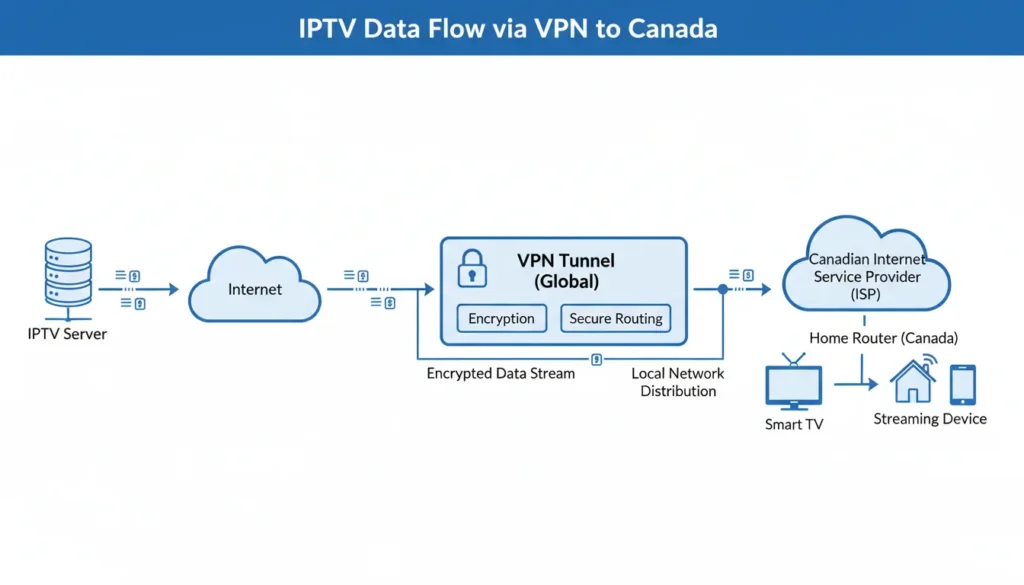
Why a VPN is Non-Negotiable in Canada
For anyone using a third-party IPTV service in Canada, a Virtual Private Network (VPN) is an essential tool. Canadian Internet Service Providers (ISPs) are known to practice ‘throttling.’ This is when the ISP detects high-bandwidth streaming from a known IPTV server and intentionally slows down your connection to reduce network congestion.
A VPN encrypts your traffic, making it impossible for your ISP to see what you are doing or where your data is coming from. This often eliminates buffering issues caused by ISP interference. Furthermore, a VPN provides an added layer of privacy, protecting your personal data from potentially unverified service providers.
Setting Up Your IPTV Service for Success
Once you have chosen a provider, the setup process usually involves an M3U URL or an Xtream Codes API login. These are simply the ‘addresses’ where the app looks for the content. For the best interface, many Canadians use apps like TiviMate or IPTV Smarters Pro. These apps allow you to customize your channel lists, hide content you don’t watch, and even record live TV if your device has enough storage.
Optimizing Your Network
To ensure 4K or HD streams run without a hitch, consider the following:
-
- Use Ethernet: If possible, hardwire your streaming device to your router. Wi-Fi is susceptible to interference from microwaves, baby monitors, and neighbors’ networks.
-
- 5GHz Wi-Fi: If you must use Wi-Fi, ensure you are on the 5GHz band rather than the 2.4GHz band. 5GHz is faster and less crowded.
-
- Router Placement: Keep your router in a central, elevated location to maximize signal strength throughout the home.
Conclusion: Making the Right Choice
The shift toward IPTV in Canada represents a move toward consumer freedom and variety. While the Best IPTV Canada options vary depending on whether you prioritize legal compliance, cost, or specific international content, the technology itself is undeniable. By choosing a provider with stable servers, using a reliable VPN, and investing in decent hardware, you can enjoy a premium television experience that rivals and often exceeds traditional cable offerings. As the industry continues to evolve, staying informed about the latest software updates and provider reputations will ensure you always have the best seat in the house.
FAQ
- What is IPTV and how does it work in Canada?
IPTV (Internet Protocol Television) delivers live TV channels and on-demand content through an internet connection instead of traditional cable or satellite systems. Canadian users can stream content on devices like Firestick, Smart TVs, Android boxes, and smartphones. - Is IPTV legal in Canada?
IPTV itself is legal in Canada when the provider has proper broadcasting and licensing rights. Services from companies like Bell, Rogers, and other licensed providers are fully authorized. Some third-party IPTV services may operate without official licensing. - What internet speed is recommended for IPTV streaming?
For smooth IPTV streaming in Canada, at least 25 Mbps is recommended for HD content and 50 Mbps or higher for stable 4K streaming, especially when multiple devices are connected. - What is the best device for IPTV in Canada?
Popular IPTV devices in Canada include the Amazon Firestick 4K Max, Nvidia Shield TV, Android TV boxes, and Formuler IPTV boxes due to their performance and app compatibility. - Do I need a VPN for IPTV in Canada?
Many IPTV users in Canada choose to use a VPN for added privacy, improved security, and to help reduce ISP throttling that may affect streaming quality. - Can I watch Canadian local channels with IPTV?
Yes, many IPTV providers offer Canadian local channels including CBC, CTV, Global, Citytv, TSN, and Sportsnet depending on the subscription package. - Why does IPTV buffering happen?
Buffering is usually caused by slow internet speeds, overloaded IPTV servers, weak Wi-Fi signals, or ISP throttling. Using Ethernet and a reliable provider can significantly improve performance. - What is an M3U URL in IPTV?
An M3U URL is a playlist link provided by your IPTV service. It contains the channel list and stream information used by IPTV apps to access live TV and video-on-demand content. - Which IPTV apps are most popular in Canada?
Some of the most widely used IPTV apps in Canada include TiviMate, IPTV Smarters Pro, XCIPTV, and MYTVOnline for Formuler devices. - Can IPTV replace traditional cable TV in Canada?
For many Canadians, IPTV has become a flexible and cost-effective alternative to cable because it offers live channels, sports, movies, and international content at lower monthly costs. - How many devices can use one IPTV subscription?
This depends on the provider. Some IPTV services allow only one connection, while others support multiple simultaneous streams for households with several users. - What should I look for in the best IPTV Canada service?
Key factors include server stability, channel selection, HD/4K quality, customer support, EPG availability, compatibility with streaming devices, and reliable uptime.